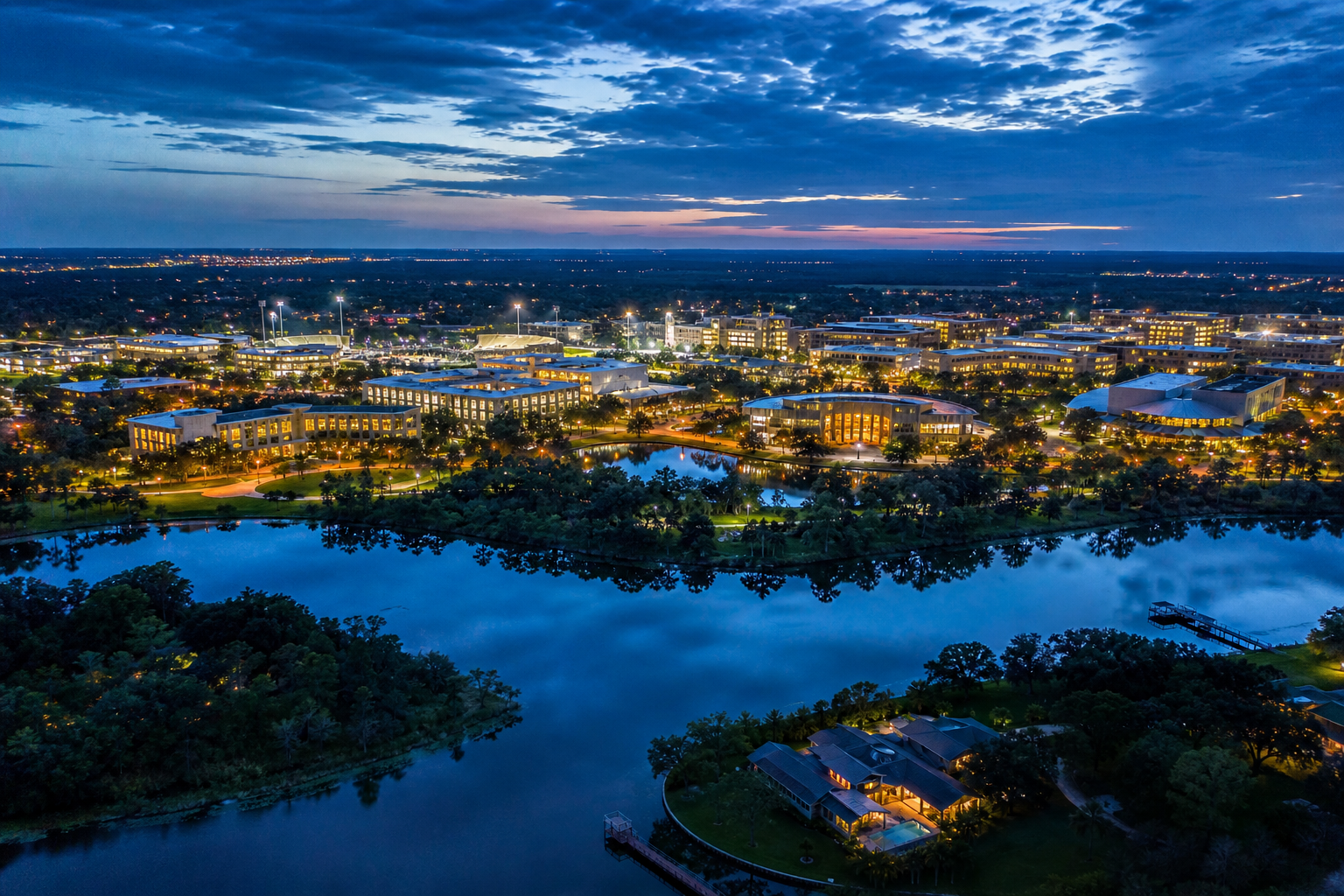
USF's enrollment of nearly 50,000 students is driving sustained housing demand in Tampa's University area and surrounding neighborhoods. With new construction permits still well below peak levels and on-campus beds limited, off-campus rental and investment properties near the Tampa campus remain in demand heading into 2026.
How is USF's growth shaping real estate opportunities in Tampa Bay?
USF's Tampa campus serves more than 41,000 students on a 1,646-acre footprint, and system-wide enrollment hit 49,875 in 2025–2026. With Hillsborough County's new construction permits still roughly 58% below their 2021 peak, off-campus housing supply hasn't kept pace with that demand. The result is a concentrated opportunity for investors and buyers who understand the neighborhoods around Fowler Avenue, Bruce B. Downs Boulevard, and the University area corridors.
Key Takeaways
- USF's total enrollment reached 49,875 students in 2025–2026, with more than 41,000 concentrated on the Tampa campus, according to the University of South Florida's published enrollment data.
- Hillsborough County residential new construction permits fell to 2,836 in 2024 before a modest rebound to 3,345 in 2025, still about 58% below the 2021 peak of 8,076 units, per a March 2026 Shovels permit analysis.
- USF's campus master plan documented plans to add approximately 2,000 net new on-campus beds, but publicly available records don't indicate that plan fully eliminated off-campus housing demand.
- Recent local market data shows a median sale price of $430,000 in New Tampa and $397,450 in Seminole Heights, two submarkets with meaningful USF-adjacent demand.
- Nearly 4,756 international students enrolled at USF in Fall 2025, representing about 9.5% of the student body, a population that tends to favor higher-amenity, furnished rental housing near campus.
What does USF's enrollment scale actually mean for nearby housing demand?
More than 41,000 students show up to the Tampa campus every semester. That's not a trend, that's a structural, recurring demand engine that doesn't slow down because mortgage rates tick up or because a developer pauses a project across town.
According to USF's own facts and statistics page, the university serves nearly 50,000 students across its campuses. The 2025–2026 enrollment figure of 49,875 students, with 37,517 undergraduates, confirms this is a large, growing institution embedded in the Tampa Bay market. A 2025 accountability plan filed with the State University System of Florida Board of Governors puts Tampa undergraduate headcount in the 37,000+ range, reinforcing that this isn't a temporary enrollment spike.
And it's not just undergrads. Admissions data from the 2024–2025 cycle shows 4,756 international students enrolled at USF in Fall 2025, about 9.5% of the student body. That population tends to prioritize furnished units, modern amenities, and proximity to campus, which creates a differentiated niche for investors willing to invest in quality rather than just location.
For a buyer or investor thinking about the University area, New Tampa, or the corridors along Fowler Avenue and Bruce B. Downs, that enrollment scale is the starting point. Every one of those students needs somewhere to live.
What the on-campus housing plan tells us about off-campus demand
USF's 2015–2025 Tampa Campus Master Plan called for adding approximately 2,000 net new student beds while replacing 1,036 beds lost to demolition of the Andros Complex. The plan also directed feasibility studies for an additional 2,000 beds, with 1,500 proposed for construction in the first five years. That plan window formally ended in 2025, and it remains the most recently published detailed housing plan available as of September 2026.
What matters for investors: even with those additions, publicly available documents don't suggest the plan was designed to eliminate off-campus housing demand. A university with 41,000-plus on-campus students and a finite residence-hall footprint will always generate overflow demand into the surrounding neighborhoods. That's not a gap in the plan, it's just the reality of how large urban research universities work.
Which Tampa neighborhoods are most affected, and what does the market look like right now?
The USF Tampa campus sits in the north Tampa/University area, anchored by Fowler Avenue to the south, Bruce B. Downs Boulevard to the east, and 30th Street as a western corridor. The submarkets that feel USF's pull most directly include the University area itself, parts of New Tampa to the north, and, for buyers and investors willing to look a bit further, Seminole Heights and Temple Terrace, which offer lower entry points with improving fundamentals.
Here's how recent local market data (trailing approximately 90 days, as of September 2026) compares across several Tampa Bay areas:
| Area | Median Sale Price | Median Days on Market |
|---|---|---|
| South Tampa | $494,995 | 45 |
| Harbour Island | $625,000 | 48 |
| Ybor City | $230,000 | 52 |
| Seminole Heights | $397,450 | 42 |
| Westchase | $550,000 | 54 |
| New Tampa | $430,000 | 48 |
These are area-level medians. An individual property's value depends on condition, street, build year, and timing, but the table gives you a useful frame for thinking about where your capital goes further and where demand is concentrated.
New Tampa at $430,000 median and 48 days on market sits closest to the USF campus footprint among these tracked areas. Seminole Heights at $397,450 with the fastest median days on market in the group (42 days) reflects a neighborhood that has been attracting attention for several years and hasn't slowed. For investors looking at entry points with proximity to both USF and downtown Tampa employment, these two areas reward attention.
What the supply picture means for investors near USF
New construction near USF isn't filling the gap. According to a March 2026 permit analysis by Shovels, Hillsborough County residential new construction permits peaked at 8,076 units in 2021, then fell sharply: 5,407 in 2022, 4,556 in 2023, 2,836 in 2024, and a modest rebound to 3,345 in 2025. That 2025 figure is still about 58% below the 2021 peak.
That constraint matters in a specific way around USF. When new supply isn't keeping pace with enrollment and population growth, pressure builds on the existing stock, older apartment complexes get renovated to justify higher rents, single-family rentals near campus hold their value, and small-scale infill projects (duplexes, townhomes, small multifamily on underutilized lots) become more viable. I've seen this play out in other university-adjacent markets, and the combination of enrollment stability and supply constraint is exactly the kind of backdrop that makes a well-located rental property a durable hold.
For context on how USF's growth fits into the broader regional story, I'd also point you to what's happening with Tampa Airport's expansion and its real estate impacts, USF is one demand driver among several reshaping Tampa Bay's housing landscape right now.
The U.S. News profile of USF describes a 1,646-acre urban campus, that physical footprint embedded in the city means the university's influence on surrounding land use and housing patterns isn't going away. It's a permanent feature of north Tampa's real estate calculus.
If you want a deeper look at how to position yourself as a buyer in a competitive Tampa Bay submarket, the early listing alerts strategy I use with buyers applies directly here, getting ahead of new inventory near USF before it hits the major portals is a real edge in a market with limited supply.
What should buyers and investors actually do with this information?
The USF growth story is real, but it's not a blanket signal to buy anything within a mile of Fowler Avenue. The opportunity is specific: properties that serve a student or faculty renter who wants quality, proximity, and convenience, and that sit in a submarket where supply constraints are likely to persist.
A few things I tell buyers and investors who are seriously evaluating this angle:
- Understand the submarket, not just the zip code. New Tampa and the University area proper have different price points, property types, and tenant profiles. A single-family home on a quiet street north of campus attracts a different renter than a condo near Fowler Avenue. Both can work, but they're different investments with different management realities.
- Think about the international student segment. With nearly 4,756 international students enrolled in Fall 2025, per Shiksha's USF admissions data, there's a segment of the rental market that values furnished units, modern finishes, and walkability over raw square footage. That's a differentiation play that not every landlord near campus is making.
- Watch the permit data. The Shovels permit analysis showing a 58% drop from peak is a supply-side signal, not a guarantee. If permitting rebounds sharply in 2026 or 2027, the supply picture changes. I track this for clients who are evaluating long-term holds near campus.
- Run your specific numbers. The area-level medians above give you a starting frame, but your actual investment thesis depends on the specific property, its condition, its proximity to campus transit routes, and the current rental market for that property type. That's where a local market analysis matters, not a Zestimate, not a county average.
USF's growth is one of several institutional demand drivers reshaping Tampa Bay. For a broader look at how those forces interact across the region, the USF expansion and Tampa Bay real estate impact overview on our site gives additional context.
Frequently Asked Questions
How is USF's enrollment growth changing the housing market around the Tampa campus?
USF's enrollment of 49,875 students in 2025–2026, with more than 41,000 on the Tampa campus, creates sustained demand for housing in the University area and nearby corridors like Fowler Avenue and Bruce B. Downs Boulevard. With new construction permits in Hillsborough County still roughly 58% below their 2021 peak, that demand is increasingly absorbed by existing rental stock, pushing up competition for well-located units and supporting property values in adjacent neighborhoods.
Is it a good idea to buy a rental property near USF for student housing in 2026?
It can be a sound strategy, but the investment case depends on the specific property, submarket, and your management approach. The structural demand from 41,000-plus on-campus students is real and recurring, and supply constraints in Hillsborough County mean new competition isn't flooding the market. That said, every investment decision depends on your numbers, financing, and timeline, the right move is to run a proper analysis on a specific property, not to assume the USF demand story automatically makes any nearby purchase a winner.
Has USF built enough new dorms, or is there still a shortage of on-campus beds?
USF's 2015–2025 campus master plan documented plans to add approximately 2,000 net new beds and study feasibility for another 2,000, but publicly available records don't indicate that those additions fully eliminated off-campus demand. For a university serving more than 41,000 students on a single campus, on-campus housing will always have finite capacity, which means off-campus neighborhoods will continue to absorb a meaningful share of student housing demand.
Which property types are most in demand around USF right now?
Both single-family rentals and apartments near campus see demand, but the tenant profile differs. International students, nearly 4,756 enrolled in Fall 2025, tend to favor furnished, higher-amenity units close to campus or along transit corridors. Domestic undergraduates and graduate students often seek single-family homes or townhomes with multiple bedrooms that can be shared. Investors who understand which segment they're targeting tend to make better property selection and renovation decisions.
How do Tampa's days-on-market and inventory levels affect investors looking near USF?
Recent local market data shows New Tampa at a 48-day median days on market and Seminole Heights at 42 days, both reflecting a market that moves with enough velocity to find deals but doesn't offer the deep discounts of an oversupplied market. For investors, that means pricing discipline matters when you're buying, overpaying in a moderately paced market is harder to recover from than in a rapidly appreciating one. Working with someone who tracks active inventory and new listings in these specific submarkets gives you a real informational edge.
The right time to think about this is before a specific property hits your radar, not after. If you're evaluating an investment near USF or want to understand what your current property is worth in this market, get a data-driven valuation as your starting point.
Get an instant property valuation here.
Equal Housing Opportunity. Patrick Uhler is a Broker Associate with Pineywoods Realty, licensed in Florida and regulated by the Florida Real Estate Commission. This article is general information only and does not constitute legal, tax, or financial advice. Confirm your specific numbers with your closing agent, tax advisor, or lender. Broker fees and commissions are fully negotiable and not set by law; no standard or typical rate exists.
:format(webp):quality(80)/u.realgeeks.media/uhlerrealestate/facebook.png)
:format(webp):quality(80)/u.realgeeks.media/uhlerrealestate/youtube.png)
:format(webp):quality(80)/u.realgeeks.media/uhlerrealestate/twitter.png)
:format(webp):quality(80)/u.realgeeks.media/uhlerrealestate/instagram.png)
:format(webp):quality(80)/u.realgeeks.media/uhlerrealestate/zillow.png)